CAN 2025: TAS verdict on Morocco-Senegal final due in November
The TAS will issue its full ruling by the end of November on Senegal’s appeal against the CAF decision that awarded Morocco the African title.
The dispute over the 35th Africa Cup of Nations final will continue until the end of November, when the Court of Arbitration for Sport is expected to issue its full sentence. The case concerns the final between Morocco and Senegal, played on 18 January 2026 at the Prince Moulay Abdellah Sports Complex. Senegal won the match on the field, but the Confederation of African Football later declared the team forfeited the final and awarded the title to Morocco. Senegal then appealed to the TAS in Lausanne.
The arbitration hearing took place behind closed doors on 8 October 2026. The panel has since begun its deliberations and decided to issue a complete decision, including the legal reasoning behind its ruling. The TAS said the process would take several weeks and that the sentence was expected at the end of November 2026. That decision will represent the final stage of the dispute after the Senegalese Football Federation challenged the CAF appeal commission’s ruling.
The controversy began during a tense final that had remained goalless through normal time. In the final minutes, Congolese referee Jean-Jacques Ndala awarded Morocco a penalty. Senegal’s players and officials disputed the decision, arguing that there had been no foul. The incident became the central point of the match, particularly because it came so late and gave Morocco an opportunity to change the outcome of the final before extra time.
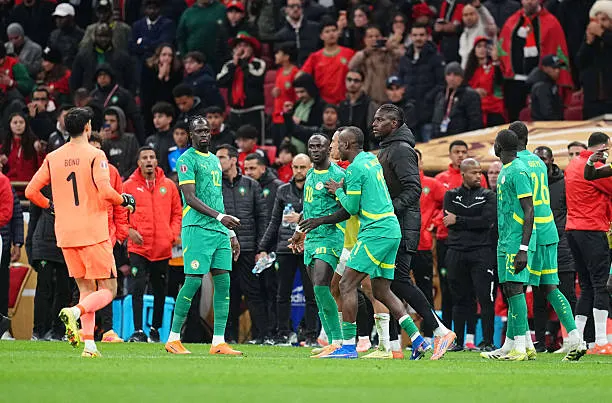
The Senegalese reaction led to an unusual interruption. The Lions of Teranga coach instructed some of his players to leave the pitch in protest. Several moved towards the dressing rooms, while others stayed on the field. Sadio Mané then held a long exchange with Claude Le Roy before asking his teammates to return. The players came back, allowing the match to continue, but the episode later became the basis of the legal action that changed the status of the final.
Brahim Diaz took responsibility for Morocco’s penalty. The Real Madrid player attempted a Panenka, but Senegal goalkeeper Édouard Mendy stayed alert and caught the ball. The save preserved Senegal’s position in the match and triggered celebrations among the Senegalese supporters. Morocco had been seeking a second continental title after its first triumph in 1976, but the missed penalty meant that the trophy would not be decided in normal time.
Senegal eventually settled the final in extra time. Pape Gueye scored to give his team a 1-0 victory, the result recorded on the pitch at the end of the match. That sporting outcome was later overturned administratively. Morocco’s federation appealed to the CAF appeal commission, challenging the conduct of the Senegalese team during the penalty incident. On 17 March, the commission declared Senegal forfeited and recognised Morocco as the champion.
The CAF appeal commission based its decision on Articles 82 and 84 of the competition regulations. The ruling created two separate versions of the final’s status: Senegal remained the winner of the match played in the stadium, while Morocco became the champion under the CAF decision. Senegal’s federation rejected that outcome and referred the case to the TAS, asking the sports arbitration body to review the forfeiture and the title awarded to Morocco.
The legal question before the Lausanne panel therefore extends beyond the penalty itself. The TAS must consider the consequences of the players’ temporary departure from the field, the applicable competition regulations and whether the CAF appeal commission was entitled to replace the result with a forfeit. The panel’s decision will also determine whether Senegal’s 1-0 extra-time victory is restored or whether Morocco retains the continental title awarded by CAF.
Until the sentence is delivered, the CAF ruling remains the operative decision in the competition record, while Senegal’s appeal remains unresolved. The TAS has not announced an immediate ruling from the October hearing and is preparing a reasoned decision rather than a brief outcome. Its sentence, expected in the final days of November 2026, will bring an end to a dispute that has kept the identity of the 35th Africa Cup of Nations champion before the courts months after the final whistle.
Source: Camfoot
 Wydad AC
 Mike Malott
 Joaquin Buckley
 Cristian Pérez